The Economics of Insight
While waiting for docking runs to finish one day, I found myself thinking about why some ideas seem disproportionately valuable compared to the effort required to discover them.
Research is often described as a process of going deeper. The deeper you go into a field, the more you understand it. This is true, but it is only part of the story.
The Escalating Cost of Depth
Imagine an infinite number of parallel staircases.
Each staircase represents a line of thought.
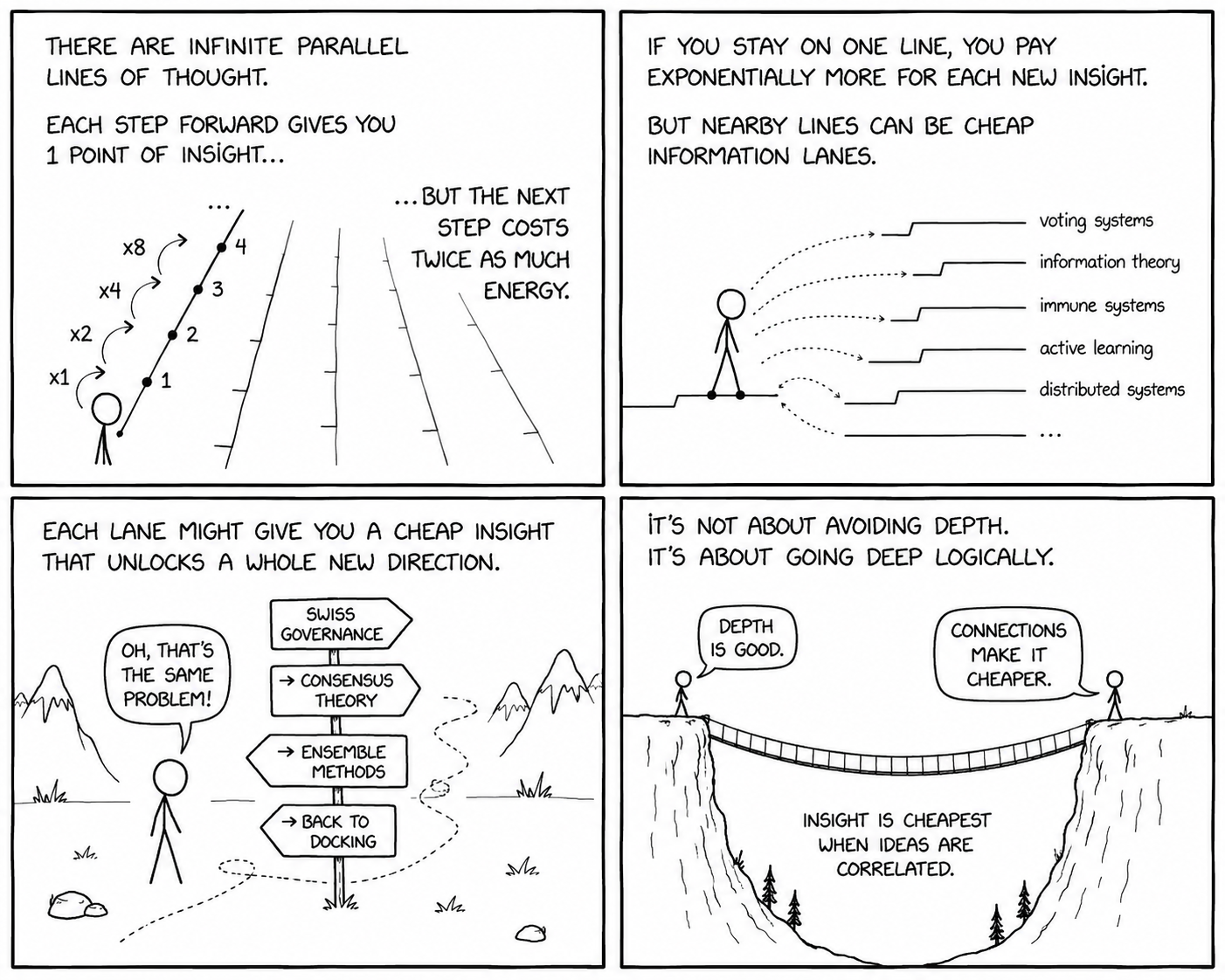
Note: This is not an xkcd comic, and is not affiliated with or created by xkcd. It is an illustration inspired by xkcd's visual style, created using ChatGPT.
You climb one step and gain one unit of insight. To climb the next step requires twice as much effort. The next step requires twice as much again. Eventually, every additional insight becomes increasingly expensive.
This is not a flaw of research. It is simply what happens when a problem is explored deeply. The obvious discoveries come first. The remaining discoveries become harder and harder to obtain.
Most researchers respond by continuing up the same staircase. Sometimes this is the correct choice.
But there is another possibility.
Sideways Steps and Neighboring Staircases
What if there are neighboring staircases?
Not random ones. Not unrelated disciplines joined together for the sake of novelty. Staircases that share an underlying structure.
- A problem in consensus docking may resemble a problem in voting systems.
- A question about ensemble learning may resemble a question about distributed governance.
- A challenge in active learning may resemble a challenge in scientific decision making.
At first glance these fields appear unrelated. Yet beneath their surface vocabulary they may be solving the same abstract problem.
Stepping sideways into a neighboring staircase can be surprisingly powerful. An insight that requires years of effort in one domain may already be obvious in another. By importing that idea, a researcher can gain information at a fraction of the cost.
The goal is not breadth for its own sake — it is finding regions where the ratio of insight to effort is unusually high.
A Personal Path Through the Network
Some of the most interesting conversations I have had with myself started this way. Here is how one unexpected chain of thoughts connected:
- A question about consensus docking led to thoughts about information theory.
- Information theory led to active learning.
- Active learning led to uncertainty.
- Uncertainty led to voting systems.
- Voting systems led to political systems designed to function despite disagreement.
- And unexpectedly, some of those ideas found their way back into computational biology.
The destination was never the point. The value came from discovering that multiple fields were attempting to solve variations of the same problem.
This process looks like wandering from the outside. In reality, it is often a highly efficient search strategy.
Curiosity as an Optimization Algorithm
Which suggests that curiosity should perhaps not be viewed as randomness.
Curiosity may be an optimization algorithm — one that searches not for maximum depth alone, nor maximum breadth alone, but for the regions of the network where the next insight is cheapest to find.
Research is often portrayed as digging a deeper hole.
Increasingly, I suspect it is better described as moving through a network, and learning to recognize when you are near a node you have not visited yet.
Enjoy Reading This Article?
Here are some more articles you might like to read next: